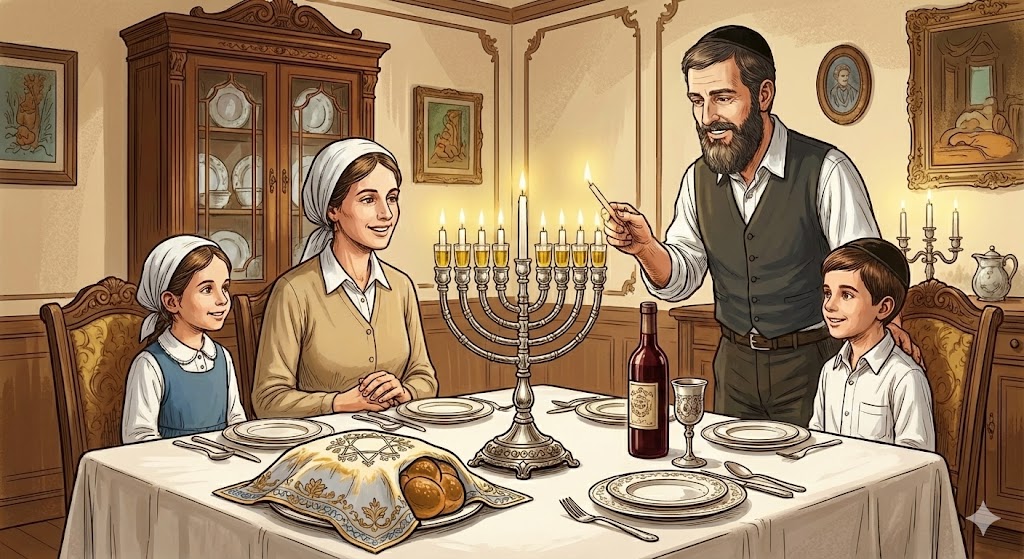
When the month of Kislev arrives and the nights become long and cold, a special magic happens in the Jewish streets. In the windows of homes, at doorways, and in city squares, small flames flicker. They start with a single candle, and every evening they multiply until they fill the house with precious light.
But beyond the sufganiyot, dreidels, and Hanukkah gelt – the essential question stands: why do we actually do this?
What is the true story behind the flame? Is it just a memory of victory in war, or is there a deep spiritual message that has accompanied us for thousands of years?
In this comprehensive and professional article, we embark on a journey following the light. We will understand the history, the law, the Kabbalistic meaning, and also the practice – how to do it properly. If you are looking to understand this holiday in depth, and not just as a nice folklore, you have come to the right place.
At HOLY LETTERS website, we live and breathe Judaica. For us, a Hanukkiah is not just another decorative object, but a holy vessel that connects heaven and earth. Let’s discover its secret together.
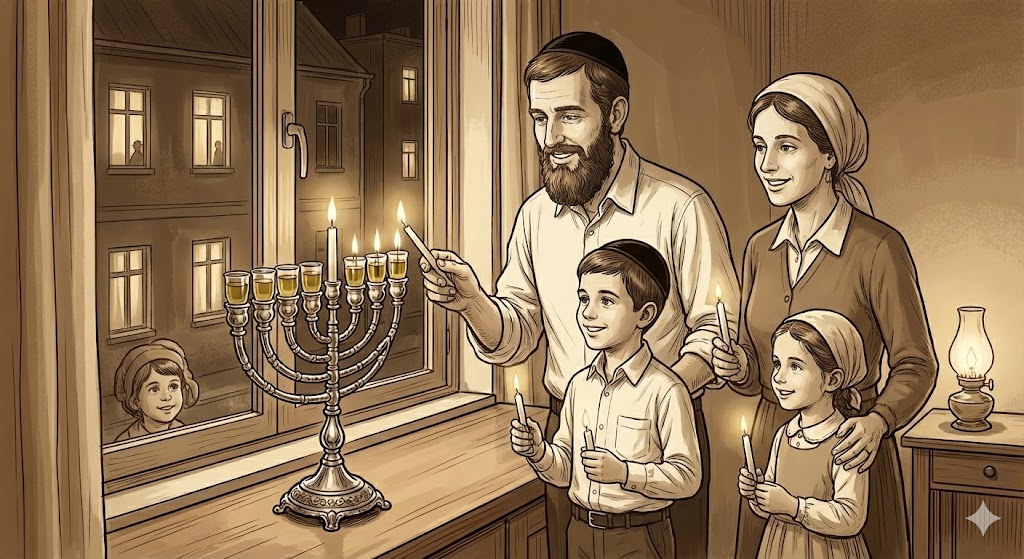
To understand why candles are lit, we need to go back in time to the second century BCE. The Land of Israel was under the rule of the Seleucid-Greek empire (the Greeks). Unlike other conquerors who wanted to kill the Jewish body, the Greeks sought something completely different: they wanted the soul.
Culture versus faith
The Greeks did not demand that the Jews stop living; they demanded that they stop being “holy” Jews. Their decree was: “Engrave on the horn of the altar that you have no share in the God of Israel.” They infused Hellenistic culture – worship of the body, sports, philosophy, and external aesthetics – and tried to erase the uniqueness of the people of Israel. They defiled the Temple, but did not destroy it. They wanted the Temple to be “Greek.”
The Revolt and the Miracle
Mattathias the Hasmonean and his sons (the Maccabees) led a revolt against all odds. Few against many, weak against mighty. The military victory was a miracle in itself, but it was not the main point.
When the Maccabees entered the liberated Temple, they discovered a terrible sight: everything was defiled. To renew the Temple service and light the “Golden Menorah,” pure and sealed olive oil bearing the High Priest’s seal was required.
After frantic searches, only one jug (small jar) of pure oil was found. The quantity was supposed to be enough for lighting for only one day. Producing new pure oil was an eight-day process.
And here the great miracle happened: the small amount of oil burned for eight consecutive days until new oil was prepared.
In memory of that miracle of the oil jug, the sages established for generations the eight days of Hanukkah, during which we light candles and give thanks for the miracles.
“Pirsumei Nisa”: The Essence of the Commandment
Unlike many commandments that we perform discreetly, the Hanukkah candle commandment is characterized by a halachic concept: “Pirsumei Nisa” (Publicizing the miracle).
The main purpose of lighting the Hanukkiah is to “proclaim” to the world that there is a Creator and Leader of the city. We place the Hanukkiah in the window facing the public domain, or at the entrance of the house from the outside (depending on customs and living conditions), so that every passerby will see the light and remember the miracle.
This is why the timing of the lighting (while there are still people on the street) and the placement of the Hanukkiah are very important. We essentially become “ambassadors of light” testifying to God’s supervision in the world.
What is the difference between a Menorah and a Hanukkiah?
Many confuse the two terms, but the difference is fundamental and historical:
The Menorah of the Holy Temple
In the Holy Temple stood a Menorah with 7 branches (seven candles). It was lit every day, not only on Hanukkah. According to Jewish law, one is not allowed to make for oneself at home an exact replica of the Temple Menorah, so you do not see 7-branch Menorahs in Jewish homes for daily use.
The Hanukkiah
Our Hanukkiah has 8 branches (and one more for the shamash, a total of 9). Why?
First, to remind of the miracle that lasted 8 days. Second, to distinguish it from the Temple Menorah. The Hanukkiah symbolizes the light descending into the darkness of exile, while the Temple Menorah symbolized the constant divine light residing in Israel.
Oil or wax? What is best to light with?
When you enter the “Sign from Heaven” website or any Judaica store, you will find various lighting options. What is preferable halachically?
Pure olive oil – the finest
It is a preferred mitzvah to light with olive oil. The reason is simple: the miracle in the Temple occurred with olive oil. The light of olive oil is clear, pure, and bright. As a “sign from heaven,” we market ready olive oil sets (small cups) that greatly ease the task and prevent mess, so you can fulfill the mitzvah beautifully without effort.
Beeswax / paraffin candles
If you don’t have olive oil, you can light with any oils and candles that give a nice light (except oils that have a bad smell or don’t burn well). Colored and regular beeswax candles are definitely kosher initially, but they are secondary to olive oil.
Electric menorah?
Important to know: An electric menorah is not kosher for fulfilling the mitzvah with a blessing.
The reason is that it does not have “oil and wick” and does not have a real fire, but rather a filament or LED light. You can light it for decoration or to publicize the miracle in public places (such as hospitals or airports) where fire is forbidden, but at home it is mandatory to light a real fire.
Lighting order: The practical guide (step by step)
So you don’t have to search on Google right before lighting, here is the exact sequence of actions as we instruct our customers:
Where to place the candles? (Arranging the menorah)
On the first night, place one candle, and each night add one candle.
Arrange the candles on the right side of the menorah.
On the first night – one candle on the far right side.
On the second night – two candles on the right side.
On the third night – three candles on the right side, and so on.
Always fill the menorah from its right side.
How to light?
Here the rule is reversed: “from left to right.”
Always start lighting the “new” candle of that day (the leftmost candle among the ones we arranged) and continue to the right to the older candles.
The idea is to honor the addition of the new day.
Indeed, there are customs to light from right to left, and some place the first day’s candle on the left side – but most of Israel follows the above custom.
The blessings
On the first night, three blessings are recited:
- “…to light the Hanukkah candle” (and some have the custom to say: “of Hanukkah”).
- “…who performed miracles for our ancestors”.
- “…who has kept us alive and sustained us”.
On the other nights (second night and onwards) only the first two blessings are recited (without “who has kept us alive”).
Additional instructions
- The shamash: The additional candle (the shamash) is meant to ensure we do not mistakenly use the holy candlelight for reading or work (“we are only permitted to look at them”). Therefore, it is lit and placed somewhat separately or at a different height than the other candles.
- Time of lighting: The candles should burn for at least half an hour after nightfall. If you use small candles, make sure they are long enough to last.
- Place: It is a mitzvah to place it a handbreadth beside the entrance, to the left of those entering (so it is surrounded by mitzvot: mezuzah on the right and Hanukkah candle on the left). Many have the custom to place it in a window facing the public domain.
Enhancing the mitzvah: why must the Hanukkiah be beautiful?
Judaism teaches not to be satisfied with merely “fulfilling” the mitzvah. There is a concept called “This is mine and I will glorify it” – to take pride before God in the mitzvot. To buy a beautiful tallit, a fine etrog, and also – a beautiful Hanukkiah.
A menorah is an item that remains in the family for generations. It passes from father to son, accumulating childhood memories, songs, the smell of latkes, and warm light. When we invest in a menorah made of pure silver, or with a unique artistic design (like our stunning “Sign from Heaven” collection), we show the Creator and our family how precious this miracle is to our hearts.
Common types of menorahs:
- Classic silver menorahs: For a luxurious and timeless look.
- Glass and crystal menorahs: Spectacular plays of light and transparency.
- Stone/concrete/metal menorahs: Modern designs for contemporary homes.
- Oil menorahs: Built with special reservoirs for oil.
Points to ponder: The light within the soul
Before we finish, here are some insights that can make your lighting more meaningful:
A little light drives out a lot of darkness
We do not fight darkness with sticks and stones. We simply light a light. When there is light, the darkness disappears by itself. In our personal lives, when we encounter difficulty (darkness), the solution is often to add a good deed (light), rather than to directly combat evil.
The soul’s oil jug
The story of the sealed pure oil jug teaches us that even when everything seems ‘defiled’ and chaotic in life, or when a person feels very far from the path – there always remains inside a ‘point of pure oil.’ The Jewish soul, the divine spark, can never become defiled. It is always possible to find it, reignite it, and it will shine beyond all natural logic.
Increasing and growing
Beit Hillel ruled that the halacha is “increasing and going” – an additional candle each day. The message is that in spirituality one cannot stand still. What sufficed yesterday is not enough for today. We must be in a continual movement of growth and adding good.
Questions and Answers (Q&A) for Hanukkah
Does each household member need to light their own menorah?
Answer: Customs differ on this. According to the Sephardic custom (“Edot HaMizrach”), the head of the household lights one menorah for the entire family, and all fulfill their obligation by his lighting and respond Amen. According to the Ashkenazi custom, it is customary that each household member (men and children) lights their own menorah to increase the light and publicize the miracle (Ashkenazi women generally fulfill their obligation through their husband’s lighting).
Is it permitted to light the Hanukkah candles before sunset?
In principle, the lighting time is at nightfall (or at sunset, depending on customs). If a person must leave the house early and return very late at night when everyone is asleep, he may light starting from “Plag Hamincha” (about an hour and fifteen minutes before sunset), provided enough oil is placed to burn until half an hour after nightfall. In this case, the blessings are recited as usual (one should ask a rabbi in a specific case).
A sign from heaven – to illuminate the home with holiness
The Hanukkah holiday is our opportunity to bring light into the home, literally. At **”Aot MiShamayim”**, we believe there is no substitute for quality and authenticity.
- Uncompromising Kashrut: All our oils, wicks, and menorahs are inspected to ensure they comply with all the intricate details of halacha. “Not kosher? Not buying!” – this is the rule that guides us.
- A variety of designs: We constantly renew the collection. Whether you are looking for a large wall menorah, a small menorah for travel, or a piece of art that will be the centerpiece of the living room – you will find it with us.
- Home delivery service: Cold outside? Rainy? Don’t go out. We will make sure the menorah and oils arrive to you with fast shipping, well packed and with a smile.
Hanukkah is a holiday of spiritual victory, beauty, and family togetherness. Don’t leave the preparations to the last minute.
Enter now the category Menorahs On the “Sign from Heaven” website, choose the menorah you’ve always dreamed of, and prepare to illuminate your home with light.
Happy Festival of Lights!