Every morning, millions of Jews around the world perform an ancient ritual. They roll up their shirt sleeves, wrap black leather straps around their arm, and place another box on their head, just above the hairline. It is an iconic sight, perhaps the most recognizable symbol of Judaism.
But if you stop a person on the street, even a traditional Jew who values the mitzvah, and ask them: “Tell me, do you know what is written inside? What text is hidden inside these leather boxes?” – you will likely receive a hesitant answer. Most of us know there is “holy text” there, maybe “Shema Yisrael,” but the exact details often remain a mystery.
We will delve into the depths of the parchment, understand which four Torah portions were chosen from the entire Torah to be placed there, discover the dramatic difference between Rashi and Rabbeinu Tam, and learn about the incredible intellectual effort required to produce these tiny parchments.
This is not just another superficial article. This is a complete guide that will make the next time you place Tefillin (or see someone placing them), you look at them with a completely different perspective – full of reverence and deep understanding.

The beating heart: The four chosen Torah portions
Inside the tefillin boxes (the black boxes) are hidden parchments made from pure animal skin, on which are written in tiny, precise handwriting four passages from the Torah. These passages were not chosen arbitrarily. They represent the essence of Jewish faith, our spiritual DNA.
Our sages explain that these four portions correspond to the four elements in the soul and to the absolute connection between a person and their Creator. Below is an in-depth analysis of each, in the order they appear in the Torah:
Parashat “Kadesh Li Kol Bechor” (Exodus 13:1-10)
The first portion deals with the remembrance of the Exodus from Egypt. This is the historical and faith-based foundation of the Jewish people.
What does it talk about?
The portion commands sanctifying the firstborn, in remembrance of the plague of the firstborn when the Lord passed over the houses of the children of Israel in Egypt. It also mentions the prohibition of eating chametz during Passover and the commandment to recount the Exodus from Egypt.
The deep message:
The recognition that our history is not accidental. There is a guiding hand. When we place this portion on the body, we testify that our bodies, our possessions (the firstborn), and our freedom—all are gifts from the Creator, and we must dedicate the “firstfruits” of our strength to Him.
Parashat “Vehaya Ki Yeviecha” (Exodus 13:11-16)
A direct continuation of the previous portion.
What does it talk about?
Here the emphasis is on arriving in the Land of Israel (“the land of the Canaanite”) and on educating the children. The famous verse “and you shall tell your son” appears in this context. It ends with the explicit commandment regarding tefillin: “and it shall be a sign on your hand and a reminder between your eyes.”
The deep message:
It is not enough to remember the past (the Exodus); the future must be secured. Holiness must pass to the next generation. The connection to the Land of Israel and education are the cornerstones of our existence. In tefillin we “bind” the future of our children to our essence.
Parashat “Shema Yisrael” (Deuteronomy 6:4-9)
The most famous text in Judaism and the eternal declaration of faith.
What does it talk about?
The uniqueness of the LORD (“The LORD is One”), the commandment to love the LORD (“You shall love the LORD your God with all your heart, with all your soul, and with all your might”), and the commandment of Torah study. Here too appears the command to bind them as a sign on the hand and as frontlets between the eyes.
The deep message:
Acceptance of the yoke of Heaven. This is total submission – in heart, soul, and wealth (“with all your might”). This section represents abstract faith, the emotional and intellectual connection to the Creator who has no body and no form of a body.
The portion “Ve’hi im shamoa” (Deuteronomy 11:13-21)
The second part of the Shema prayer.
What does it talk about?
The principle of reward and punishment. If you obey the commandments – there will be rain, abundance, and blessing in the land. If, heaven forbid, you turn away from the path – the land will not yield its produce. It ends with a promise of longevity (“so that your days and the days of your children will be prolonged”).
The deep message:
Acceptance of the yoke of the commandments. Faith is not only in the heart (“Hear, O Israel”), but requires practical expression in daily life. Our actions have consequences. The world is not ownerless; there is law and a Judge.
The internal architecture: the difference between head and hand
Many think that inside the “boxes” there is simply one rolled-up scroll. Well, this is only true for half of the commandment. There is an essential and structural difference between the head Tefillin and the hand Tefillin, a difference that teaches us a fascinating psychological lesson.
Hand Tefillin (the long box)
In the hand Tefillin, all four of the aforementioned portions are written on one long continuous scroll, inside a single compartment (bayit) completely unified.
The significance:
The hand symbolizes the deed, the execution. In the world of action, there is no division. The act must be one, focused and unified. All the different values (memory, education, faith, reward and punishment) must crystallize into one clear and sharp action. Likewise, the hand is opposite the heart – and the heart must be whole with the Creator, without division.
Head Tefillin (the divided compartment)
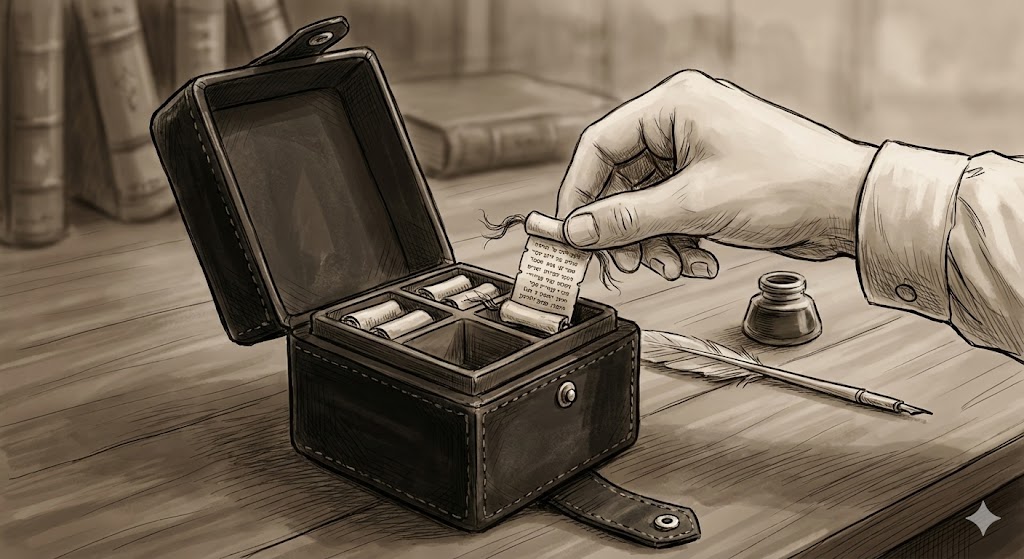
If you look closely at the head tefillin from above, you’ll see that it has four small compartments. The “house” is divided intofour separate cells. Inside each cell sits a separate scroll on which one of the four passages is written. They are not physically connected but lie side by side.
The significance:
The head is the dwelling of intellect and thought. The human brain is composed of different chambers, different faculties and diverse perspectives. On the intellectual level, it is permitted and even desirable to have distinctions between different subjects. Each passage receives its own “room,” its unique place in consciousness. The completeness of the brain is created out of the multiplicity of opinions and details, not from forced uniformity.
The great dispute: Rashi or Rabbeinu Tam?
If you entered a synagogue and saw people wearing two pairs of tefillin (either simultaneously or one after the other), you probably asked yourself – why?
Here we enter one of the most fascinating issues in Jewish law, concerning the core arrangement of the passages inside the compartments.
The dispute is between two great Torah giants who were also relatives: Rashi (Rabbi Shlomo Yitzchaki) and his grandson, Rabbeinu Tam (Rabbi Yaakov ben Meir).
Rashi’s method (the central halacha)
According to Rashi, the order of writing the parshiyot and their placement inside the tefillin (from right to left of the wearer) is chronological, exactly as they appear in the Torah:
- Kadesh
- Vehaya Ki Yeviacha
- Shema
- Vehaya Im Shamoa
This is the method accepted by all of Israel, and every Bar Mitzvah boy starts with the ‘Rashi’ tefillin.
Rabbeinu Tam’s Method
Rabbeinu Tam disagrees with the order of the last two parshiyot. According to his approach, the order is:
- Kadesh
- Vehaya Ki Yeviacha
- Vehaya Im Shamoa
- Shema
That is, he reverses the order between ‘Shema’ and ‘Vehaya Im Shamoa’.
Why is this critical?
If the order of the parshiyot is incorrect, the tefillin are completely invalid. A person who puts on tefillin with the incorrect order is considered as if they never put on tefillin at all!
Since the Shulchan Aruch ruled that the primary halacha follows Rashi, but instructed that ‘a God-fearing person fulfills the obligation of both,’ many have the custom (primarily among Hassidim, Kabbalists, Mizrahi communities, and today many Lithuanian Jews) to put on also Rabbeinu Tam’s tefillin, to ensure the mitzvah is fulfilled according to all opinions.
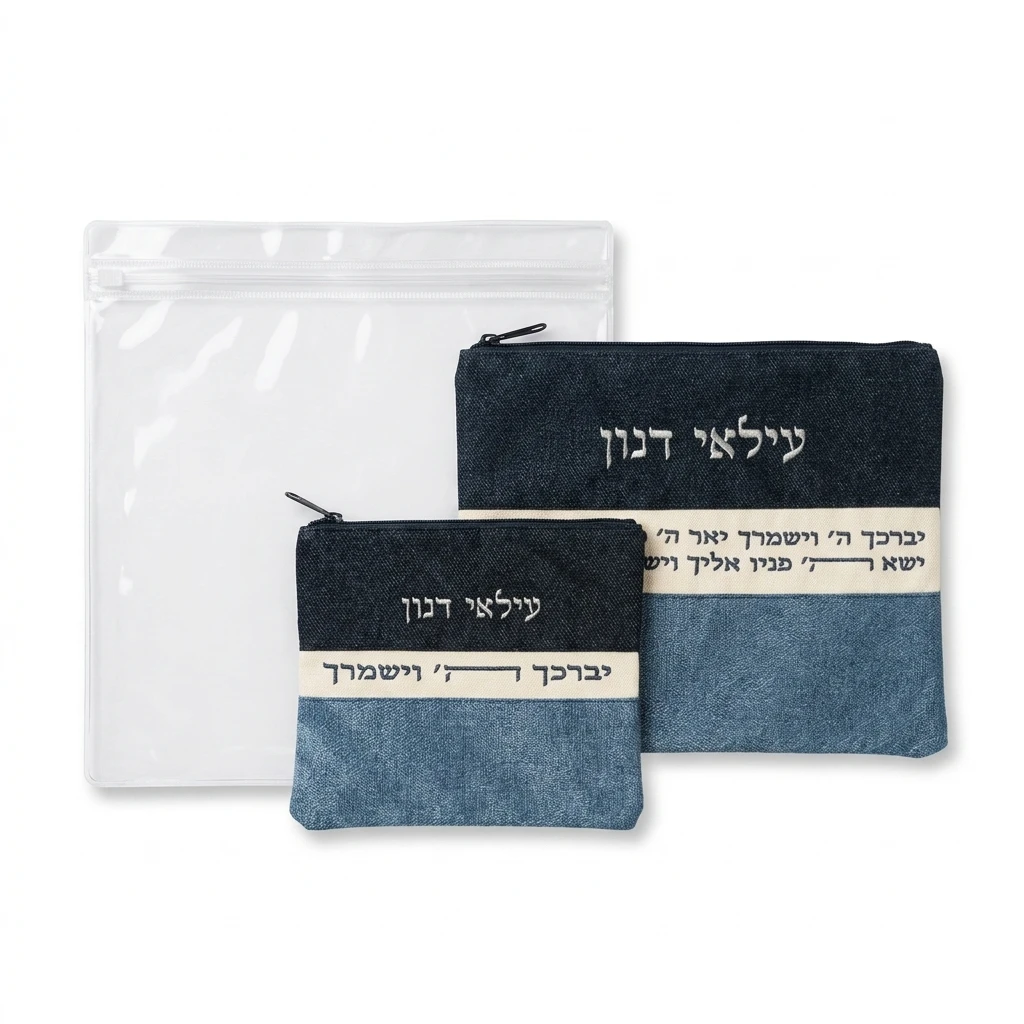
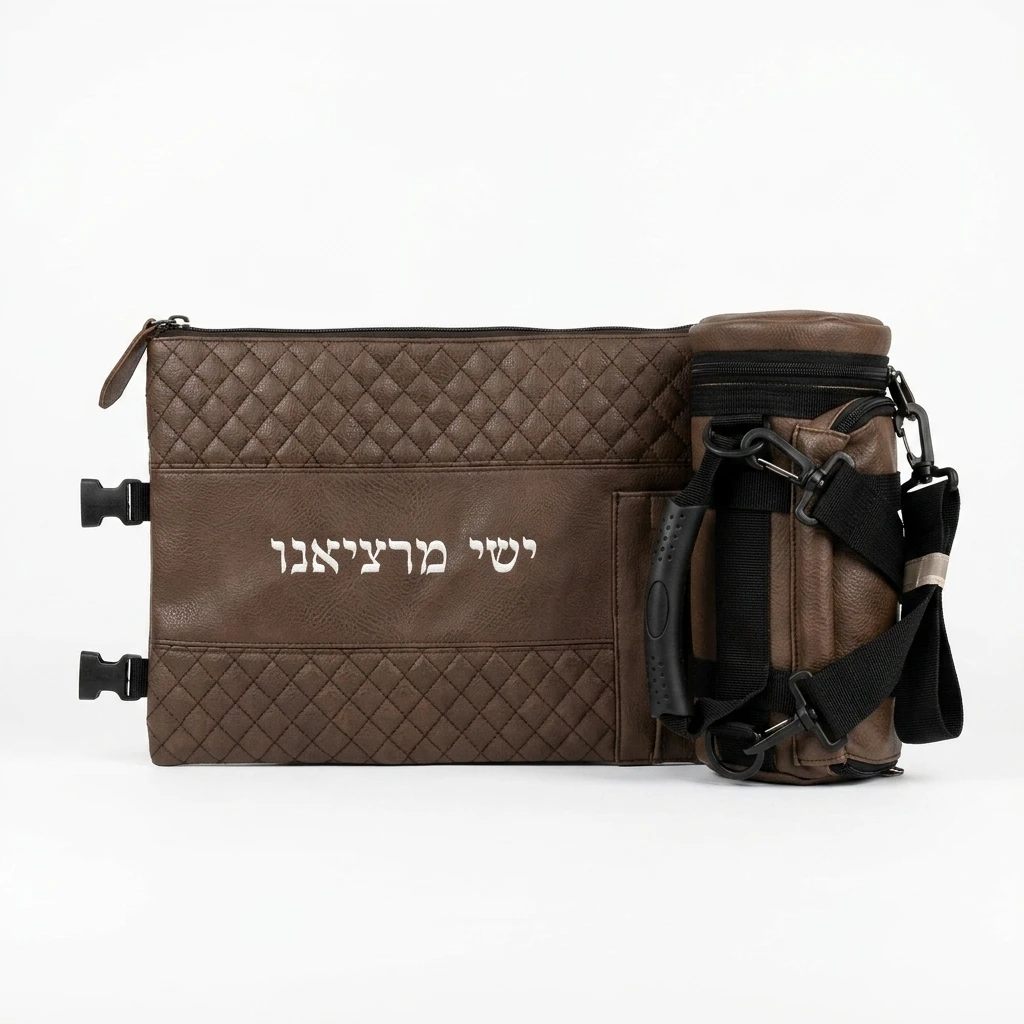
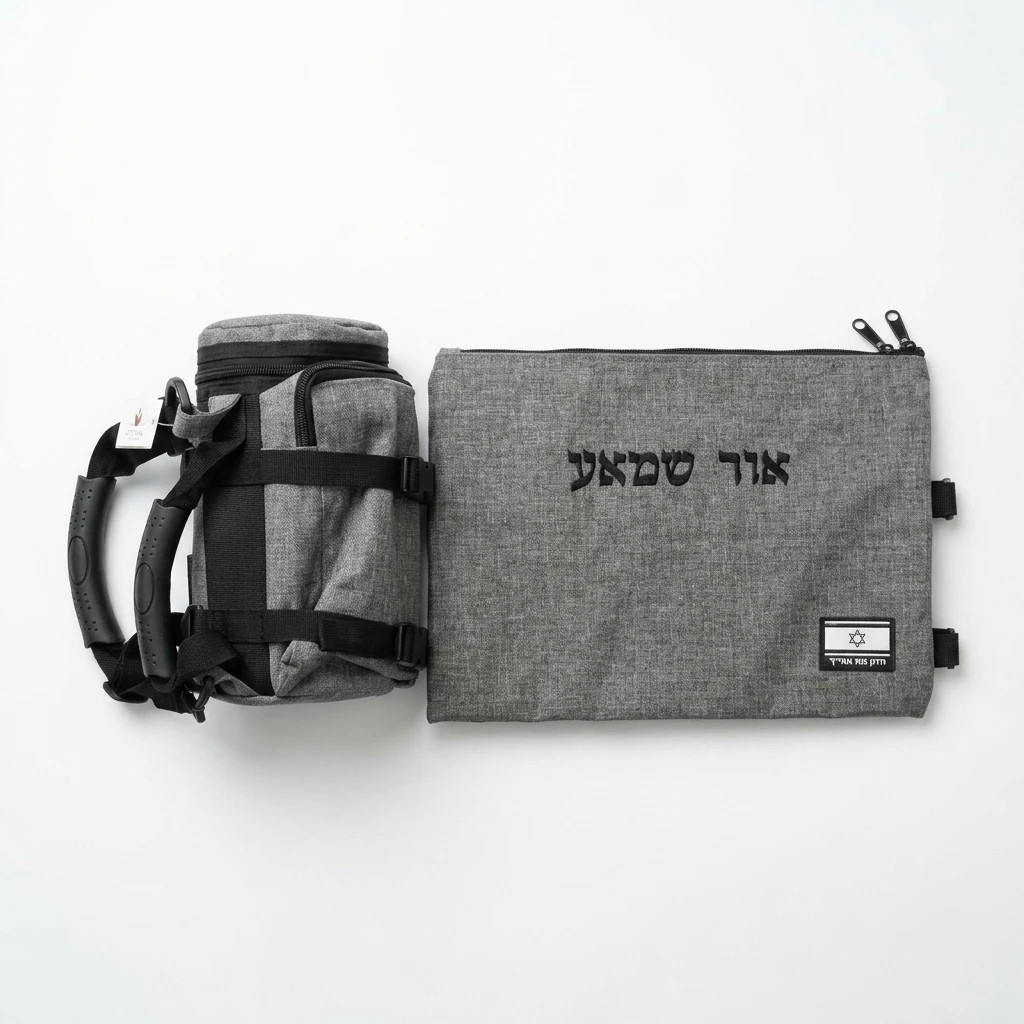
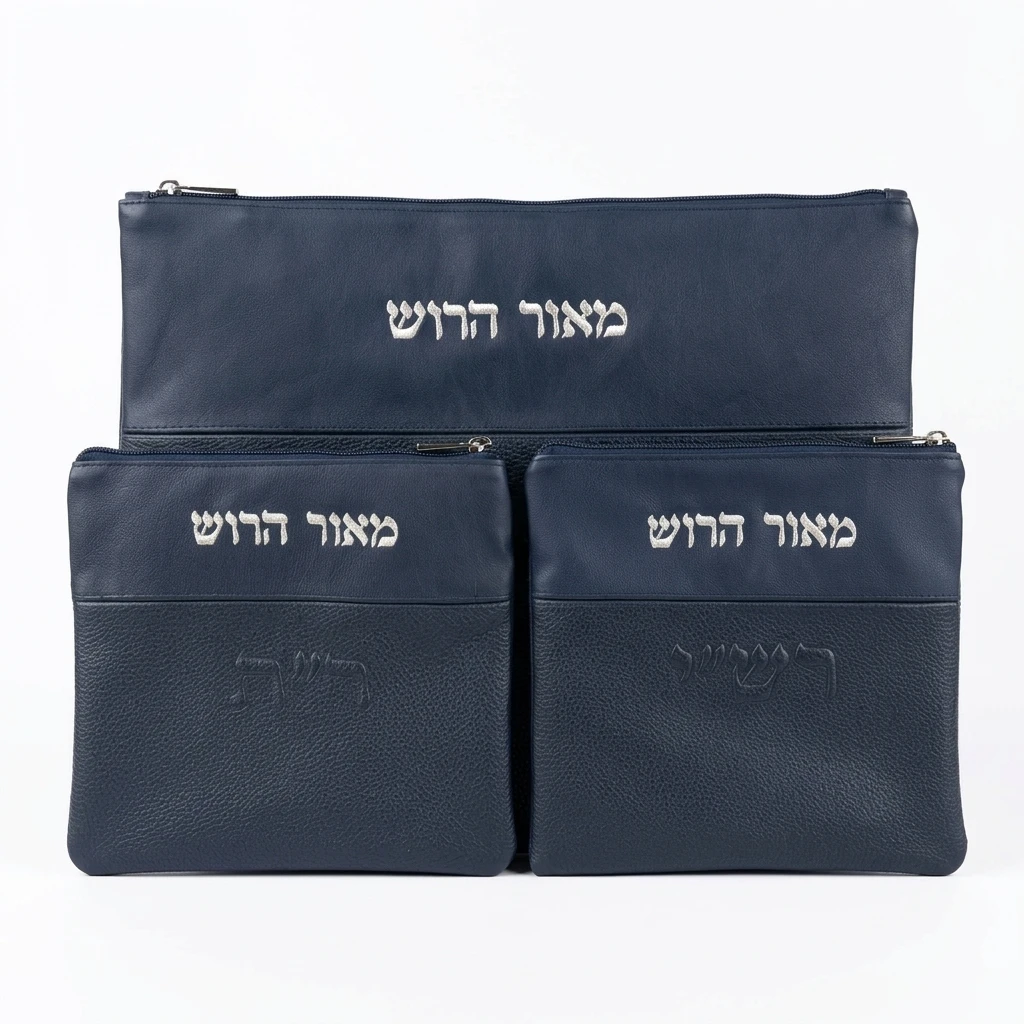
At HOLY LETTERS, we offer elegant sets including both pairs in matching bags, to allow you to fulfill the mitzvah in the highest completeness and without doubts.
Sofer STaM: How are the parchments written?
Writing the parshiyot for tefillin is not a matter of ‘copy-paste.’ It is a craft requiring skill, holiness, and microscopic precision. At HOLY LETTERS, each parchment is carefully checked, with human proofreading plus computer verification. The computer check with the parshiyot contained in the tefillin is attached to every purchaser. It is important for you to understand the process behind preparing the tefillin.
The parchment (the base)
The writing is done on a “klaf” – the skin of a pure animal that has undergone a special processing with lime and scraping for the mitzvah of tefillin (“leshem shamayim”). The skin is polished until it becomes smooth and pleasant to the touch, and durable for many years.
The ink and the quill
The ink must be deep black, made from natural materials (such as tree resin smoke, kansatam, and gum). The writing is done with a quill – usually a feather (among Ashkenazim) or a reed (among Sephardim), which allow flexibility and precision in the thickness of the line.
The intention (“leshem shamayim”)
Before the scribe dips the quill into the ink to write the Holy Names of Hashem in the sections, he must say aloud: “I am writing for the sanctity of the Name.” If he wrote without this intention – the klaf is invalid! A machine cannot write tefillin, because a machine cannot have intention.
Complete writing and “carved letters”
The letters must be written completely. If one letter touches its neighbor, or there is a gap inside a letter – the tefillin are invalid. Moreover, the letter must be written (“vechtavtem”) and not engraved. One cannot scrape away ink to form a letter.
Writing styles
There are three main writing styles, and it is important to know what you are ordering from heaven:
- Beit Yosef script: The Ashkenazi script common among the Lithuanian stream. A stable and squared script.
- The Arizal script: Similar to Beit Yosef but with kabbalistic changes in the shapes of the letters, customary among Hassidim and Kabbalists.
- Velish (Sephardi) script: The script common among Eastern communities. The letters are more rounded and have a different flow.
Checking tefillin: Do you have to check them periodically?
As a rule – if we purchased mehudar tefillin for Bar Mitzvah, they remain considered kosher as long as there is no reason to fear they have become pasul due to being wet, struck, or lying in a certain place without use. In any case, it is customary among pious people to check the tefillin once a year (many do so in the month of Elul) or at least every few years.
The enemies of the parchment
- Heat: Did you leave the tefillin in the car during the Israeli summer? Heat can dry out the ink and cause the letters to crack or crumble (“ink jumping”).
- Moisture: Sweat or high humidity can cause the parchment to swell, letters to blur or stick to each other.
- Time: Even under optimal conditions, the ink can fade over the years and turn reddish or gray (invalid).
Nowadays, by the grace of Heaven and in leading institutes, the checking is done doubly: a computer scan that examines the parchment and identifies minimal gaps and adhesions that the human eye might miss, and also a certified human proofreader who checks the shape of the letters and halachic validity.
Questions and answers (Q&A) on the sections of the tefillin
Is there a difference in the content of the sections between Ashkenazim and Sephardim?
The text itself is exactly the same for all Jewish communities (except changes in the form of certain letters). The main difference is in the handwriting style (font) and the shape of the Shin found on the head tefillin.
I saw that the scribe adds “crowns” on the letters. What is that?
These are called “tags.” There are certain letters on which the scribe draws thin ascending lines (tags). According to Kabbalah, these tags are spiritual “antennas” that connect the letters to the higher worlds. The absence of tags does not always invalidate retroactively, but initially, it is an absolute requirement.
Why are the parchments of the head rolled up in the hair?
When opening the head tefillin, you see that each parchment is wrapped in an additional parchment and rolled up in calf hair. This is a fascinating halachic detail (“Halacha given to Moses at Sinai”). The hair must come out and be visible on the side of the bayit (the head tefillin shell). The purpose is to remind of the sin of the calf and atone for it, and to show that we have transformed animality into holiness.
A sign from heaven – the responsibility behind the parchment
At Ot Mishamayim, we understand that tefillin are the most sensitive and important product a person buys in their lifetime.
- Without compromises: We work with God-fearing scribes who have valid certification (“Stam Guardianship” or equivalent bodies).
- Transparency: With every purchase of premium tefillin, we include a photograph of the parchments before sealing, a computerized check certificate, so you know exactly what you are placing on your head.
- External and internal beautification: We ensure that the bayits (shells) are made from quality raw materials and that the parchments inside are of high, clean, and elegant writing quality.
Do not compromise on the beating heart of the commandment. Tefillin are bought once in a lifetime (or every few years), and it is important that the investment is made where you are guaranteed unquestionable kashrut.
In summary: the letters that connect us
In the end, these four parchments – Kadesh, Vehaya Ki Yeviacha, Shema, and Vehaya Im Shamoa – are our story.
They tell us where we came from (the Exodus from Egypt), where we are going (the Land of Israel and educating the children), what we believe in (the unity of God), and what our responsibility is in the world (observing the commandments).
When we wrap the tefillin in the morning, we are not just performing a religious act. We take our history, faith, and values, and physically bind them opposite the brain (intellect) and against the heart (emotion and action). We charge ourselves with spiritual energy that accompanies us throughout the work or study day.
The next time you put on tefillin, try to focus for a moment on the words written inside them. Let the ancient letters soak in. This is the power of the Jewish people, and it is right there, within reach, inside the black box on your head.
Searching Deluxe Tefillin For Bar Mitzvah or renewing the commandment? Tefillin for the groom or for everyday use? Enter the tefillin category on the HOLY LETTERS website and enjoy peace of mind, halachic quality, and service that puts you at the center.