It seems that there is no more familiar daily Jewish practice than washing hands. This action, of pouring water from a vessel (netilah for washing hands) over the palms, accompanies the believing Jew from the moment of awakening in the morning, through bread meals, and during various moments throughout the day. But have we ever truly stopped to ask— Why?
Why water? Why specifically the hands? And what is the connection between a simple physical act and the highest spiritual holiness?
In this comprehensive article, we will dive deep into one of the central mitzvot in Jewish daily life. We will not settle for superficial answers, but will explore the historical, halachic, ideological, and even mystical roots of washing hands. We will understand the differences between the various washings, learn how to perform them correctly in practice, and discover how this simple vessel placed next to the sink holds entire worlds of meaning within it.
We at the site “HOLY LETTERS”, specializing in high-quality and exquisite Judaica, believe that enhancing a mitzvah begins with knowledge. The more we understand the depth of the mitzvah, the more meaningful our connection to it will be, and the tools we use will become more than just objects — rather, genuine vessels of holiness.
Not just a rinse: The three pillars of washing hands
When we seek to clarify the reason for the mitzvah, we find there is no single answer. The Sages of blessed memory, throughout the generations, pointed to several intertwined reasons that create a complete picture. Broadly, the reasons can be divided into three main categories: cleanliness and hygiene before the service of God, holiness and purity (a reminder of the Temple), and the removal of evil spirits (mysticism).
A Reminder for the Temple: Hands as a Serving Vessel
The roots of the commandment are deeply embedded in Jewish history, dating back to the days of the Temple. The priests, before approaching the sacred service and offering sacrifices, were required to sanctify their hands and feet by washing from the basin. King Solomon, with his wisdom, instituted hand washing also for eating sacred foods (sacrificial meat), to ensure the priests’ hands were completely pure.
Later, the Sages decreed that we too, “a kingdom of priests and a holy nation,” should behave with a certain level of sanctity at our dining table. The Jewish dining table was considered an altar, and the food upon it like a sacrifice. Therefore, before eating bread, we wash our hands to resemble the priests in the Temple.
Removal of Evil Spirit: The Mystical Dimension
This reason is especially dominant in the morning hand washing (but not only then). According to the holy Zohar and Kabbalistic teachings, during sleep the soul ascends upwards, and the body remains in a state of “minor death.” This state allows forces of impurity (called the “evil spirit” or “Sitra Achra”) to serve, mainly at the fingertips. Pure water, when poured in a particular order, removes that negative energy and purifies the person in preparation for a new day.
Cleanliness for Prayer and Blessing
The third reason is more practical and simple, but no less important: honoring God. Before we turn to the Creator in prayer (for example, in Shacharit, Mincha, or Maariv) or recite a blessing, we must be clean. Our hands are “working hands” — they touch everything, and often become dirty with things that are improper. Washing the hands ensures we stand before the King with clean hands, physically and spiritually.
Good morning world: The secret of the morning hand washing
The first moment of the Jewish day begins with water. Even before we put our feet off the bed, or immediately upon rising, we seek the washing. Morning hand washing differs from the washing before bread in several ways, and it carries the meaning of a “new creation.”
Man as a new creation
The Rashba (Rabbi Shlomo ben Aderet), one of the great early authorities, explains a beautiful idea: in the morning we become like a “new creature.” God returns to us a fresh and renewed soul. Just as the High Priest sanctified his hands in the morning before performing the service in the Temple, so do we sanctify our hands to begin the work of our day in this world. This is a declaration that we are ready to serve the Creator in the new day given to us as a gift.
Caution: Do not touch!
Because of that “evil spirit” mentioned, Halacha emphasizes not to touch the openings of the body (eyes, nose, ears, mouth) before washing the hands in the morning. The reason is that the impurity resting on the hands could harm those sensitive parts. Therefore, in many homes, they prepare the washing cup and basin (negel vasser) next to the bed to wash immediately upon waking.
The order of the morning washing
Unlike washing for a meal, in the morning the order is “alternating.” The aim is to “pass on” the impurity from hand to hand until it completely leaves.
This is how to do it correctly:
- Hold the vessel in the right hand.
- Move it to the left hand.
- Pour water over the right hand.
- Move the vessel back to the right hand and pour over the left hand.
- Repeat the process a total of 3 times for each hand (some are stringent and do 4 times).
The kings of the meal: hand washing for bread
Bread is the most basic food for humans (“bread sustains the heart of man”), and in Judaism it holds a special status. Only over bread do we recite the “Grace After Meals” blessing (and not “Creator of souls” or “for sustenance”), and only bread requires washing hands with a blessing.
When do you wash?
It is mandatory to wash hands when intending to eat bread in an amount of “an egg’s volume” (about 56 grams). If eating less than an egg’s volume, there are opinions that you wash hands without a blessing (to avoid doubt regarding blessings).
Why specifically bread?
Bread is connected to the laws of “Terumah” – the gifts given to the priests. Since priests were required to eat the terumah in a state of ritual purity, the sages decreed that every person, even one who is not a priest and even in times without a Temple, must eat their bread in purity so that the law of purity will not be forgotten by Israel. This is an educational act that preserves the national memory of the Temple service.
The vessel that makes the difference: the ‘Netilah’ (hand-washing cup)
You cannot talk about hand washing without discussing the central vessel – the Netilah. It is not just any cup; it has precise halachic (Jewish law) requirements, and this is exactly where our expertise at **”HOLY LETTERS”** comes in.
What makes a vessel kosher for washing?
For a vessel to be kosher for hand washing, it must meet several conditions (of course it is not possible here to detail all the components explained in the Talmud and Shulchan Aruch, but we will write in general terms).
- Capacity: The vessel must hold at least a “Revi’it” of water (about 86 ml, although ideally a much larger amount is used to wash the hand abundantly).
- Integrity: The vessel must be whole. A crack or hole through which water leaks may invalidate the vessel.
- Smooth rim: The rim of the vessel (from which the water flows) must be smooth and without significant defects.
- Capacity vessel: The object must be defined as a “vessel” intended to hold liquids, not just a broken piece of a vessel.
Hidur Mitzvah – This is Eli and Anvehu
Beyond basic kashrut, there is a significant matter of “Hidur Mitzvah.” When we use a beautiful, designed, and elegant vessel, we show that the mitzvah is dear to our hearts. A netilah is an item used frequently on a daily basis, and it is placed in a prominent spot in the kitchen or dining area.
At the HOLY LETTERS website, we offer a stunning collection of netilot made from various materials:
- Stainless steel and silver: For a luxurious, modern, and clean look that does not rust.
- Ceramics and porcelain: In artistic designs, colorful and hand-painted.
- Glass and copper: For a unique and authentic look.
All our netilot are carefully tested to ensure they meet the strictest halachic requirements (“Not kosher? Not buying!”, remember?), while simultaneously enhancing the appearance of every sink and washing area.
Water: the source of life and purity
The water itself is a topic on its own. Not every liquid is kosher for hand washing.
- Tap water: The best and most accessible water is regular tap water.
- Water whose appearance has changed: Water that has had color added (like ink) or has become very dirty – is invalid.
- Water that has had work done on it: If the water was used for another purpose (e.g., soaking vegetables or cooling a bottle) – it is invalid for washing.
A point to consider: Water symbolizes kindness and the Torah (“There is no water except Torah”). When we pour water on our hands, we are essentially anointing the power of our action (the hands) with the power of divine wisdom and kindness.
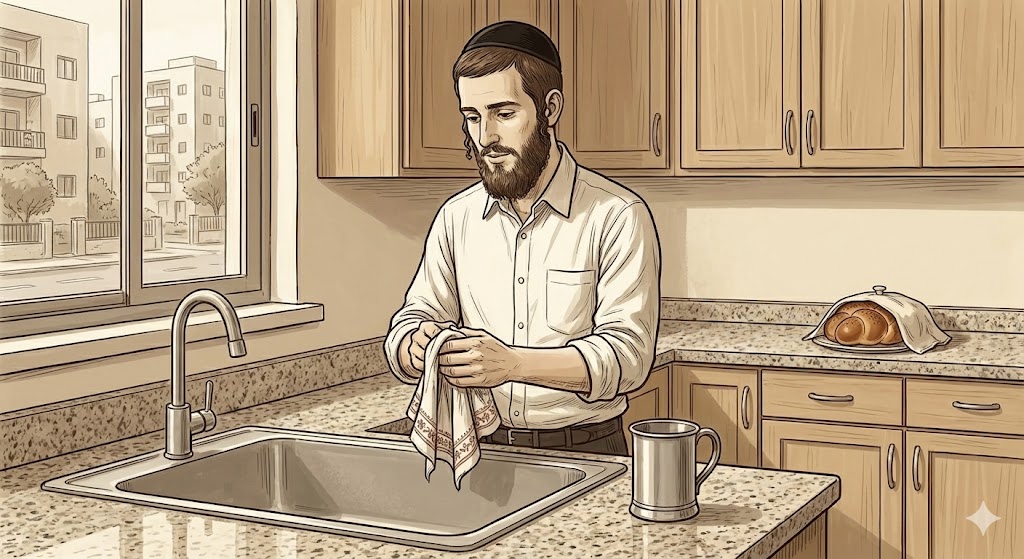
The practical guide: How to do netilat yadayim for a meal? (Step by step)
To fulfill the mitzvah properly, it is important to follow the correct order. Here is the complete guide to washing before eating bread:
Step 1: Checking cleanliness and barrier
Before washing, ensure that the hands are free of physical dirt. Also, rings should be removed (especially for women, but also for men if they usually remove them), as they constitute a “barrier” – preventing water from reaching the skin underneath the ring.
Step 2: Grasping the washing vessel
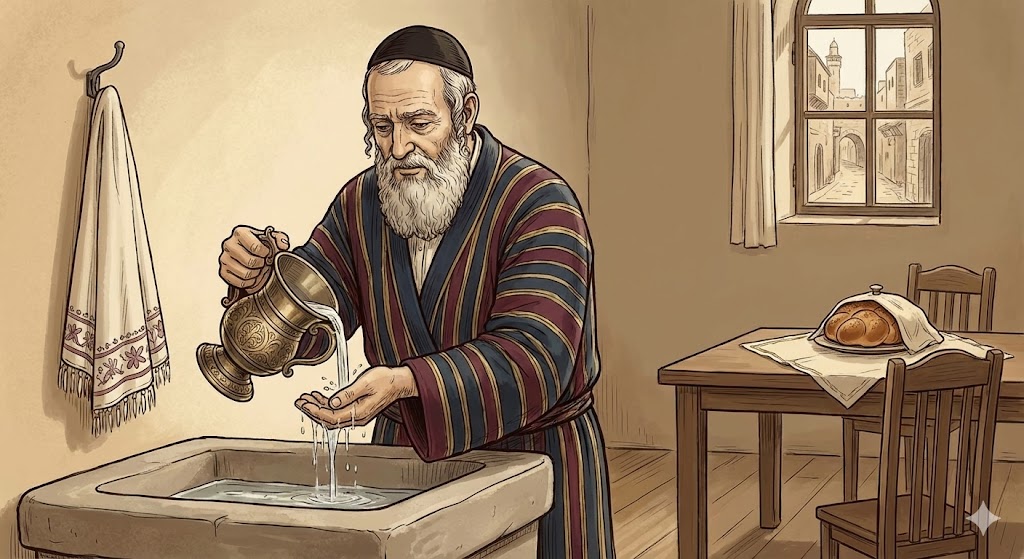
Fill the washing vessel with water abundantly. Take the vessel in the right hand and pass it to the left hand. (We want the right hand, which is important, to be the one to start cleaning itself, so the left hand serves it and pours water over it).
Step 3: The washing itself
- Pour water over the palm of the right. Make sure the water covers the entire palm up to the wrist joint (the connection to the arm).
- It is customary to pour twice on each hand (and some have a custom of three times), so that the first water purifies the hand, and the second water purifies the first water on the hand.
- After finishing with the right hand, pass the vessel to the right hand and pour over the left hand (in the same manner – twice or three times).
Important note: Unlike the morning washing (alternately), in washing for a meal one finishes washing one hand first and only then proceeds to the other.
Step 4: Rubbing and raising the hands
After pouring the water, some have the custom to rub the hands together slightly. Then, raise the hands to head level (or at least to heart level) facing the face, and say the blessing.
Step 5: The blessing and drying
Before drying (while the hands are still wet), recite the blessing:
“Blessed are You, LORD our God, King of the universe, who sanctified us with His commandments and commanded us regarding the washing of the hands”
Very important: Hands must be wiped thoroughly Immediately After the blessing and before lowering them down or doing any other action. Wiping is part of the commandment! It is forbidden to eat with hands wet from water that was not wiped off.
More opportunities: When else should hands be washed?
Hand washing is not limited only to morning and bread. There are other situations in Jewish life that require hand purity (without a blessing):
- Leaving the bathroom (toilet): It is obligatory to wash hands every time you leave the bathroom, both for cleanliness and to remove evil spirit.
- Cutting nails and haircuts: Actions related to removing parts of the body require washing afterward.
- Leaving a cemetery or a funeral: After contact with death or proximity to it, hands should be washed (usually there is a washing vessel at the cemetery exit).
- Touching covered areas of the body: Anyone who touched places on the body that are generally covered, or scratched their head, needs to wash hands before prayer or Torah study.
The depth of things: Why is it called “washing” (netilat) and not “washing” (rechitza)?
The term “hand washing” (netilat yadayim) is unique. We do not say a blessing “on washing hands” or “on rinsing hands.” Why?
There are two beautiful explanations for this:
- From the root of vessel (antal): The word “netilah” is derived from the Greek/Aramaic word “antal,” meaning a vessel to hold water. The blessing itself emphasizes that the action is done using a vessel and not just flowing water.
- From the root of elevation and lifting: “Netilat Yadayim”. When we wash our hands, we are not just cleaning them. We are “lifting” them from the mundane, raising them upwards and sanctifying them. The hands transform from a physical tool into a spiritual vessel capable of bringing abundance into the world.
A sign from heaven – where beautification meets service
As we have seen, hand washing is much more than hygiene. It is a declaration of holiness and connection to an ancient tradition. To fulfill this mitzvah with joy and comfort, it is important to have the right tools.
In our online store, “HOLY LETTERS”, we understand these subtle nuances.
- Halachic precision: We know exactly what makes a washing cup strictly kosher. You will not find any cups with defects in rim or capacity here.
- A vast variety: Whether you are looking for a gift for a young couple, a luxurious washing cup for Shabbat, or a practical and durable cup for children – we have it all.
- Service from the heart: Did your cup break during delivery? Do you have a halachic question about the product? Our friendly and personal team is always available for you.
We believe buying Judaica is not like buying an ordinary consumer product. It is buying part of your Jewish home. Therefore, we ensure fast home delivery (even within 24 hours if you are pressed!).
In summary: points to consider
Next time you approach the sink, hold the washing cup handle and look at the flowing water, take a small moment of attention.
Remember that you continue a chain of generations of priests, sages, and simple Jews who in every place and circumstance maintained this purification.
Remember that this water cleans not only the skin but also the soul.
And remember that your hands, those hands that work, cook, hug, and write – are holy hands worthy of blessing.
Washing hands is proof that Judaism does not believe in escaping the physical world, but in sanctifying it. We take water (matter), a vessel (matter), and hands (body), and elevate them to the level of divine service.
Want to upgrade your washing corner and add beauty to the mitzvah? Visit now the washing category on the website A sign from heaven And choose the vessel that will expand your knowledge every morning anew!